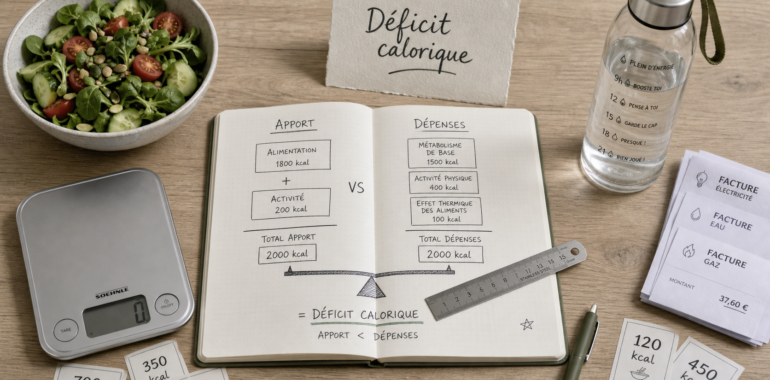
A calorie deficit means you eat fewer calories than your body burns. That energy gap is what links it to weight loss and fat loss. The key is to keep it moderate and measurable, because a plan that is too strict is hard to maintain, while a plan that is too vague is hard to track.
What a calorie deficit really means
Your body needs energy every day to stay alive, move, digest food, think, maintain body temperature, and support physical activity. Food supplies that energy in the form of calories. When the calories you eat are lower than the calories you expend, you are in a calorie deficit.
Calculateur de déficit calorique
Estimez vos besoins énergétiques pour atteindre vos objectifs de poids.
For example, if your body needs 2500 kcal in a day and you consume 2000 kcal, the difference is a 500 kcal deficit. That does not make the body stop working. It means the body must use stored reserves to cover the gap. If that pattern continues over time, body weight tends to go down.
Calories are a unit of energy. In technical terms, a calorie is the amount of heat needed to raise the temperature of 1 gram of water by 1ºC. In nutrition, the label usually uses kilocalories, shown as kcal, but everyday language often shortens this to “calories.”
Calorie deficit, weight loss and fat loss are related, not identical
Weight loss means the number on the scale goes down. Fat loss means the body uses stored body fat as part of the energy gap. A calorie deficit is necessary for weight loss, and when it is maintained in a sensible way, it pushes the body to use energy reserves, mainly fat. Still, the scale can change for other reasons too, such as water, food volume, digestion, and training. That is why day-to-day weight is not always a perfect measure of fat loss.
Where your daily calorie expenditure comes from
To understand a deficit, it helps to look at the other side of the equation: calorie expenditure. Your body does not burn calories only during workouts. A large part of daily energy use comes from basic functions that continue even at rest.
Basal metabolic rate: the energy cost of being alive
Basal metabolic rate, often shortened to BMR, is the energy your body uses at rest to maintain vital functions. Breathing, circulation, cell activity, and temperature regulation all require calories. This is why two people can eat the same amount and see different results. Weight, height, age, sex, and activity level all affect energy needs.
One commonly used way to estimate basal metabolic rate is the Mifflin St. Jeor equation:
- Men: BMR = 10 x weight in kg + 6.25 x height in cm – 5 x age in years + 5
- Women: BMR = 10 x weight in kg + 6.25 x height in cm – 5 x age in years – 161
This gives an estimate of resting energy needs, not your full daily expenditure. To get closer to total needs, you still have to include movement, exercise, work activity, steps, and overall lifestyle.
Exercise helps, but it is only one layer
Physical activity increases calorie expenditure and can make a deficit easier to create without cutting food too sharply. Walking, strength training, cycling, swimming, and sports all count. Exercise still does not replace nutrition planning. If training makes you much hungrier or leads to extra eating, the intended deficit can disappear without you noticing it.
How to calculate your calorie deficit without overcomplicating it
You do not need perfect numbers to begin, but you do need a reasonable estimate. The practical goal is to compare what you eat with what your body likely spends, then adjust based on progress, hunger, energy, and sustainability.
Comprendre le métabolisme de base : définition et calcul — Discover the scientific definition of basal metabolic rate and learn how your body consumes energy at rest.
Step-by-step calculation
- Estimate your basal metabolic rate using a formula such as Mifflin St. Jeor or a calorie deficit calculator.
- Add activity level to estimate total daily energy expenditure, including work, exercise, and daily movement.
- Track average calorie intake for several typical days, not just one unusually strict or indulgent day.
- Create a moderate gap by reducing intake, increasing activity, or combining both.
- Review the trend over time rather than reacting to one scale reading.
A calculator can be useful because it brings weight, height, age, sex, and activity level into one place. But it remains an estimate. Your real-life response is the final feedback. If weight does not move over time, the deficit may be smaller than expected. If energy and hunger become hard to manage, the deficit may be too large.
A simple example you can picture
Think of daily energy balance as a loop, not a single number. Food intake, movement, hunger, sleep, training, and motivation all affect each other. A slightly longer walk may make meals easier to manage later in the day. A very harsh restriction may increase cravings, reduce movement, and push you back toward your starting point. The useful point is simple: a calorie deficit is not just a number to subtract once. It is a plan to stabilize so that meals support energy, activity stays repeatable, and tomorrow’s choices do not undo today’s effort.
That is why consistency matters more than perfection. A plan that fits normal life is easier to repeat, and repetition is what makes the energy gap meaningful over time.
What is a safe and realistic calorie deficit?
A commonly mentioned target from Bupa Salud is to reduce between 300 and 500 calories per day. This range is practical because it is large enough to create progress but usually less extreme than severe restriction. It can come from eating slightly less, moving more, or both.
For many beginners, a 300 kcal deficit feels easier to keep than a sudden 500 kcal cut, especially if the current diet is irregular. Someone who already exercises and eats consistently may tolerate the higher end better. The right number depends on body size, activity, habits, and how well the plan can be maintained.
| Element | What it means | Why it matters |
|---|---|---|
| Calorie intake | Calories from food and drinks | This is the side you can adjust through nutrition |
| Energy expenditure | Calories burned daily | Includes vital functions, movement, and exercise |
| Basal metabolic rate | Energy used at rest | Forms the base of daily calorie needs |
| Physical activity | Movement and exercise | Can increase the deficit without only cutting food |
| Daily deficit | Intake below expenditure | A moderate target is often 300 to 500 calories per day |
Why food quality still matters
A calorie deficit can produce weight loss, but nutritional quality affects how you feel while doing it. A diet made only of low-calorie snacks may fit a number and still leave you hungry, tired, or short on useful nutrients. A balanced diet with protein-rich foods, vegetables, fruits, whole grains, healthy fats, and enough fluids is usually easier to maintain because it supports satiety and daily function.
This is also where people should avoid compensatory attitudes. Skipping meals to “make up” for eating, punishing themselves with exercise, or cutting calories more aggressively after a normal fluctuation can make the process stressful and less sustainable.
Making the deficit work in real life
The best calorie deficit is not the lowest one. It is the one you can repeat while still living normally. Successful fat loss usually comes from small, consistent decisions rather than a short burst of restriction.
Use exercise to support the plan, not to punish eating
Exercise is valuable because it raises energy expenditure, supports fitness, and can help preserve motivation. Strength training may be especially useful for body composition, while walking is accessible and easy to recover from. The key is to choose activity you can repeat. If a workout plan leaves you exhausted and hungrier than before, it may not support the deficit as well as expected.
Watch the trend and adjust calmly
If you are estimating calories, give the process enough time before changing everything. Body weight can move up and down even when fat loss is happening. Look for a general trend, then adjust intake or activity gradually. A smaller plate, fewer liquid calories, an extra walk, or more structured meals can be enough to restore progress without making the plan extreme.
People with medical conditions, a history of disordered eating, pregnancy, or specific health concerns should seek professional nutrition guidance before starting a calorie deficit. For everyone else, the safest starting point is clear: estimate your needs, aim for a realistic gap, prioritize food quality, and build habits you can maintain beyond the first weeks.